
Key Stakeholders in NHS Workforce Wellbeing: An Orientation Guide
By Alice Miller and Karen MattickAlice is a Knowledge Mobilisation Fellow funded by the NIHR Applied Research Collaboration (South West Peninsula) and a consultant in Acute Medicine at Torbay Hospital in Devon. Karen is a Professor in Medical Education and Healthcare Workforce at the University of Exeter and part of the NIHR-funded CARES-Well workforce research partnership, which is working in partnership with health and social care colleagues to identify how to create healthy workplaces where staff will want to work, feel productive and can thrive.
The wellbeing of the UK’s healthcare workforce is a nationally important priority. Poor mental health and wellbeing among staff costs the NHS an estimated £12.1 billion a year, and sickness absence rates in the NHS are double the national average. We have known that the experience of NHS staff is linked to patient experience of care for many years. In response, many organisations put in place plans and projects to improve wellbeing, but often, these are:
Focused on individuals (rather than recognising the contribution of teams, organisations and systems)
Reactive (offered to people when problems arise rather than seeking to prevent the development of poor wellbeing)
Discrete and short-term (acting as a “sticking plaster” rather than creating a sustainable longer-term solution)
To support the development and implementation of wellbeing interventions with a broader focus, we have produced a schematic (below) to provide an overview of stakeholders within the workforce wellbeing landscape. This is offered as a useful resource for individuals (healthcare staff or researchers) to conceptualise who is involved in staff wellbeing at different levels of the healthcare system, and to work out who to liaise and engage with to improve workforce wellbeing.
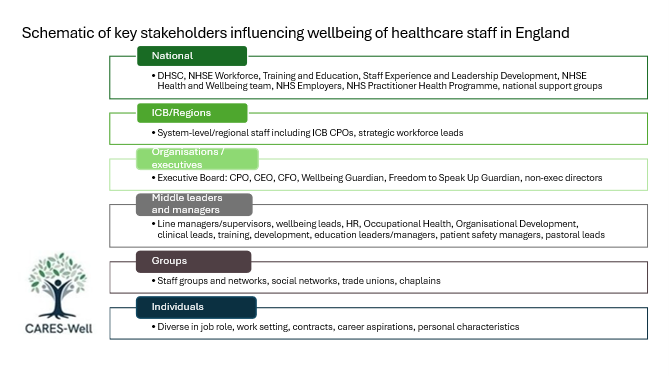
We suggest considering the following tips when using the schematic:
1) Think about creating connections
In an ideal world, there would be connections between the levels, with each group or individual representing a node in a network. Well-developed connections between nodes would allow different parts of the system to interact and work together in a flexible and collaborative way. In reality, within the hierarchical structure of the NHS, interactions between or within system layers are variable and often limited. Liaison with individuals and groups at multiple levels can help to forge connections, develop relationships and share expertise.
2) Map the territory
Many of the roles and groups on the list do not have a specific remit around staff wellbeing or experience. Workforce wellbeing is closely connected to organisational culture and leadership. Some leadership roles will have wellbeing or staff experience time allocated or recognised in their portfolio, role descriptor or job plan, but others will not. Individuals juggling many competing priorities may not see wellbeing as a primary responsibility, which can limit their influence or authority in this sphere. Conversely, there will also be clinical and managerial staff with expertise and influence in the wellbeing arena (“champions”) who are not identified on this schematic, and who may be identified by word of mouth. As well as identifying the individuals involved at the different levels, it will be important to assess whether and to what extent they are connected currently, with a view to nurturing connections and relationships that can benefit staff wellbeing organisationally. Mapping out an organisation’s approach to wellbeing, and its full range of wellbeing support provision, can help you locate interested people who can work together to improve staff experience.
3) Cultivate your knowledge mobilisation skills
The NHS loves a quick fix. In trying to improve staff experience, you may feel under pressure to “deal with the wellbeing problem”. But context is everything, and transplanting a toolkit or prescribed intervention (without considering the context into which you are introducing it) is unlikely to bring measurable or sustainable improvement at an organisational level. Approaching with more of a knowledge mobilisation mindset might be more successful. For example, be a knowledge broker, find your champions, build a community of practice and think about patient and public involvement and engagement. Prioritising dialogue (rather than relying on passive information dissemination) and fostering trusted relationships with stakeholders brings opportunity, serendipity and connection. Co-design and co-production of projects and interventions will help to embed positive change in the system and create lasting beneficial effects.
4) Don’t give up
Some approaches might not be successful, but you can move on and find another avenue to explore. Be reflexive and document your journey. Finding a forum to share your reflections can also bring learning to a wider wellbeing audience. Engage with likeminded communities nationally and get inspired by the rapidly developing evidence base around improving working lives. And we know that small changes can make a big difference for NHS staff and thus ultimately for patient care.
Acknowledgments and Disclaimers
We would like to gratefully acknowledge the important conversations that have shaped this blog, including with: Iain Lang, Jill Maben, Cath Taylor, Ruth Abrams, Cherry Hirst, Graham Hieke, Safina Nadeem, Emily Williams, Kevin Croft, Juliet Rayment, Daniele Carrieri, Alison Pearson, Kathryn Bamforth and Keira Broom. The insights shared above were developed as part of research that was funded by the National Institute for Health Research (NIHR) Health & Social Care Delivery Research programme. The views expressed are those of the authors and not necessarily those of the NIHR or the Department of Health and Social Care.
Find out more
Knowledge mobilisation:
Implementation, knowledge mobilisation and impact: A cross-ARC guide - ARC South West
Underpinning research:
CARES-Well website: www.cares-well.co.uk
Care Under Pressure website, University of Exeter: https://sites.exeter.ac.uk/careunderpressure/
Workforce research website, University of Surrey: https://workforceresearchsurrey.health/projects-resources/